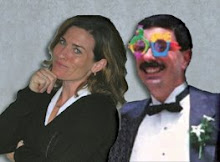
Does that mean 3D mammography plus 3D glasses adds up to 6D? I’m not sure, but they call it 3Dimensional Stereo Digital Mammography and the images definitely popped off the screen. Actually, they were viewing 3D images acquired from a full-field digital mammography system instead of individual slices displayed in 2D from 3D data sets. The idea is to see behind overlapping structures and read breast-imaging exams faster.
McKesson also featured a 3D monitor for viewing 3D clinical images - a heart beating in the air. If this type of visual enhancement proves to be useful for diagnostic accuracy, there may already be millions of radiologists in training – but most of them busy playing AVATAR.

Since, Mitsubishi made 3D video gaming a reality earlier this year with the release of Nvidia 3D technology on one of its 3D-enabled TVs, as well as on home entertainment PCs, with a souped up graphics card of course, software now creates 3D imagery from regular video games, and some day regular 3D volume data sets.
By the way, Avatar is a new video game that uses the same 3D technology as the James Cameron sci-fi movie, also called Avatar. Talk about back to the future, it’s like 3D at the movies in the 1950s when Hollywood was losing viewers to TV and released 3D flics to regain popularity. Hmmm...sounds like Hollywood today is banking on AVATAR to do the same.
Back to reality, in a study presented at RSNA 2009, and conducted at the Mayo Clinic in Rochester, Minn., researchers used 3D stereotactic surface projection (3D-SSP) software to improve accuracy in diagnosing Alzheimer’s disease. 3D-SSP has been used in some centers and is thought to improve the accuracy of experts, said Vance Lehman, M.D., lead author of the study, which included 54 patients (23 normal and 31 cognitively impaired individuals). Two readers with less than one year of experience and two nuclear medicine experts with at least 10 years of experience viewed and rated all the PET scans. The readers ranked the scans from 1 to 5, with 1 as a normal scan and 5 as severe dementia. They also evaluated the scans for diagnostic confidence, with 1 as uncertain diagnosis and 5 as complete diagnostic certainty. During the 3 to 3.5 years of patient follow-up, no one in the normal group developed cognitive impairment, which confirmed their initial diagnosis. To my knowledge, the images were not projected on 3D-enabled monitors nor were the clinicians wearing 3D glasses, but don’t be surprised if they do in a follow-up study.
Now that it’s looking more and more likely that 3D technology will soon be a common modality to view volumetric, live images in radiology rooms and in the ORs, maybe they should hand out free 3D glasses at next year’s RSNA – and win back some its popularity.
Note: On December 3, LG Display Co. of Seoul, Korea, rolled out, the world’s first commercial launch of 3D LCD panel boasting full HD resolution. The new 23-inch 3D monitor LCD panel is used with shutter glasses that deliver full HD resolution.
PACSman: Some women are easily impressed, and so too it seems to be with Ms P. and 3D. While tomosynthesis is a relatively new technology and has only been around 20 years or so, 3D has actually been around since 1922. Three D had its Golden Era in the mid 50’s, a revival in the 60’s and 70’s and went to a new dimension in the mid 80’s with IMAX film. Today many films can be found in 3D, including the latest from PIxar Studios, Up.
I’ve seen nearly every iteration of 3D imaginable, and while it’s really cool and does have its benefits in healthcare, the costs are still fairly substantial, even though they have dropped in recent years. Processing requirements also remain fairly intense as well. Reimbursement will largely determine whether 3D thrives or dies on the vine, but for now, like its film counterpart, medical 3D is enjoying a revival of sorts.
There was a lot shown at RSNA, but very little was what I consider earth shattering or that helped me justify the $1,500 it cost me to go this year. Unlike the vendors and even Miss P who works for a company, it all comes out of my pocket. Of course with the show being in Chicago Miss P also had the option of sleeping in her own bed at night and didn’t have to spend $225 a night to call some place home, so that’s yet another inequity I had to deal with.
3D really didn’t catch my attention anywhere near as much as it did Ms. P.’s , but then I am the world’s biggest cynic as well and focused mainly on PACS. What did catch my interest was the promotion of cloud-based solutions as an alternative to image distribution via the web… We’re still a few years out from making this a widespread reality and with it commensurate pricing, but the concept is still intriguing nonetheless. So why show it if its not real? RSNA - Real System Not Available. Next question. A few vendors are doing alpha and beta testing of their cloud solutions so within the next year or two these will become more and more real…
So what exactly does a cloud-based system do? Cloud-based systems allow multiple disparate systems to upload images and reports to a central data repository, or "cloud," and then resend them out to various clients from a single site. This is crucial in making a cardiologist, orthopedists or others’ job easier, especially since the clinician typically covers multiple hospitals. Instead of having to log into four, five or six disparate systems at various hospitals or deal with CD’s that all too often don’t work properly, they simply log into the cloud and viola - instant access to all their studies that have been downloaded for them. Of course, like everything, there is a cost associated with this that the hospital pays and currently that costs is quite high, but within a year or so once, these are more than a concept, then you’ll see prices drop.
There were the obvious improvements to PACS that every vendor made a big hoopla over. VNA’s all over the place, data migration services being offered by a host of vendors, and, of course, a number of Rajivs in Ramanathapuram’s Radiology Renderings, Inc. who offered teleradiology services at a price that my dog wouldn’t even touch.
Would I go to RSNA again? I feel the same way that vendors do - you have to go because if you don’t it raises more questions than not, and once you start you can’t stop even though each year its becoming harder and harder to justify the costs. Of course, over 100 vendors out of the 700 or so who displayed at RSNA 2008 didn’t show up at RSNA 2009 - so it does happen. I just can’t let it happen to me, especially since the PACSMan Awards are among the top five stories to come from the floor of the RSNA, and people look forward to a little levity in their lives. God knows we all need some after walking all over creation and back listening to so much bull I feel like I’m in Dallas instead of Chicago. But as I’ve grown to know after more than two decades of shows, it’s all a part of the game…and next year I may even get to see to see RSNA virtual - and in 3D!!